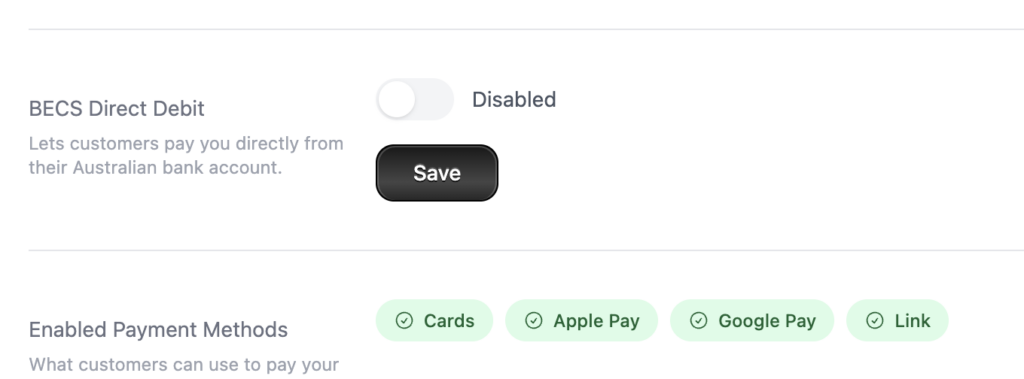
If you do not want customers to pay by direct debit, you can turn off the BECS Direct Debit switch in Setup > Settings > Stripe. Once saved, direct debit will no longer be offered as a payment option at checkout for your studio.
Who Can Change This Setting
This setting is available to studio users with Owner or Finance access.
Your Stripe onboarding must also be fully completed before the direct debit switch can be changed.
How To Disable Direct Debit
Go to Setup.
Open Settings.
Select Stripe.
Find the BECS Direct Debit setting.
Turn the switch off so it shows Disabled.
Click Save.
What Happens Next
After you save:
you should see a confirmation message that BECS Direct Debit disabled
the switch should remain in the Disabled position
BECS Direct Debit should no longer appear in the Enabled Payment Methods list on the same page
If You Cannot See Or Change The Switch
Check the following:
Stripe onboarding is complete
you have Owner or Finance access
Stripe payment methods are loading normally
If Stripe has not finished onboarding, complete that first and then return to Setup > Settings > Stripe.
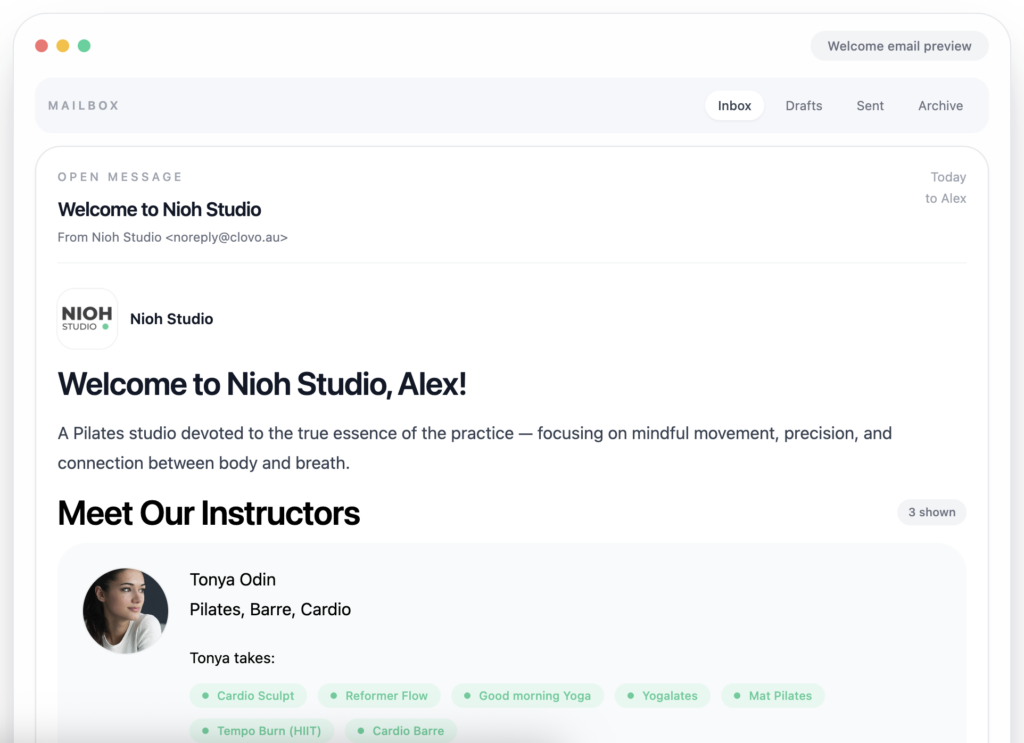
You can now customise the welcome email your studio sends to new clients when they join.
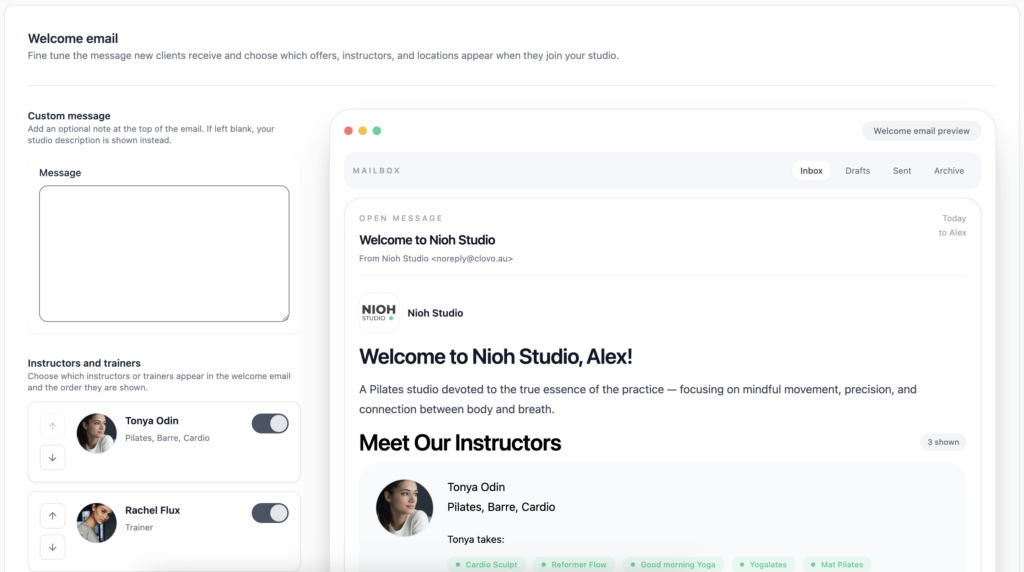
This lets you add your own welcome message, choose which offers and details appear in the email, and control the order they are shown in. A live preview on the right updates as you make changes, so you can see how the email will look before you save.
What you can customise
In the Welcome email settings, you can:
Add a custom welcome message at the top of the email
Keep your formatting in that message, including line breaks and spacing
Choose whether to show or hide:
Membership plans
Packs
Trials
Instructors or trainers
Locations
Change the order these sections appear in the email
Send yourself a test email to check the result
If you don’t want to customise your welcome email Clovo will choose safe defaults out of the box.
How to update your welcome email
In the dashboard, go to Settings.
Open Welcome email.
Add or edit your custom message.
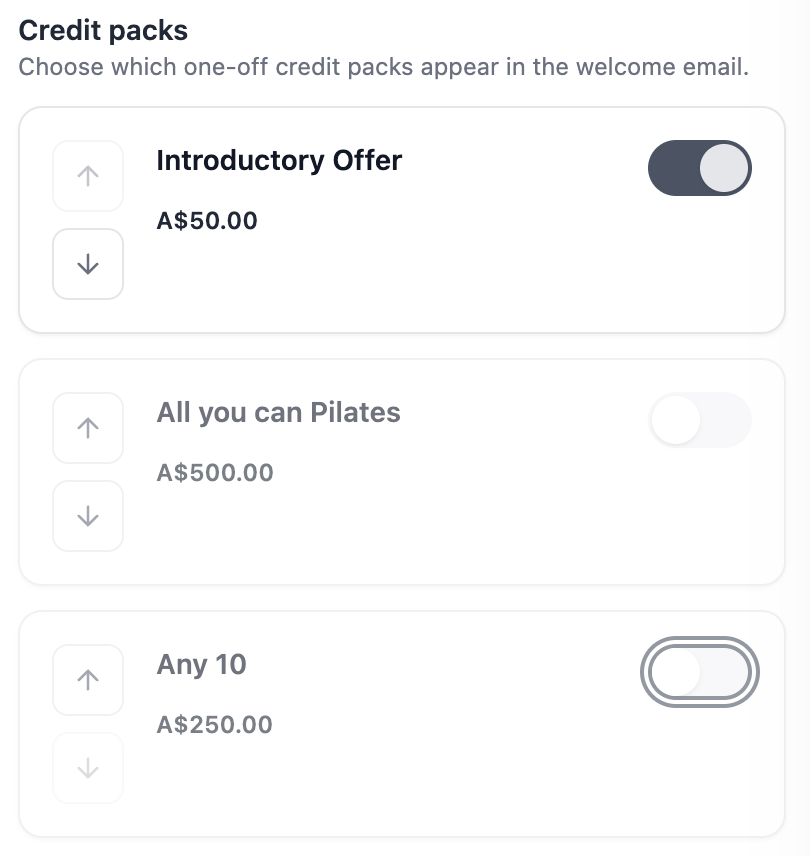
Use the controls on each item to:
Show or hide it
Move it up or down
Check the live preview on the right as you make changes.
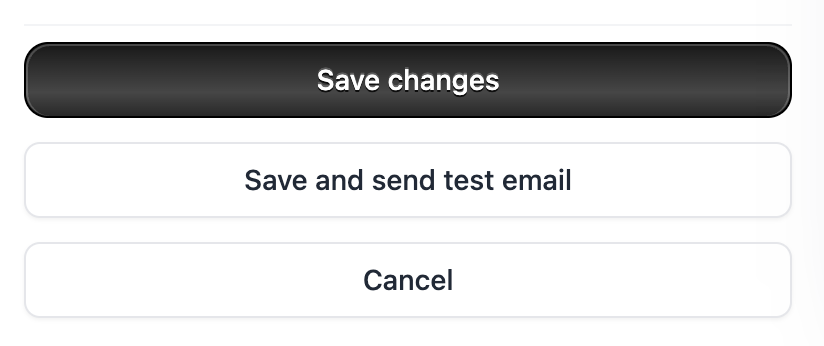
Click Save changes to save your settings.
If you would like to send yourself a copy at the same time, click Save and send test email instead. The test email is sent to the email address of the user who is currently logged in.
How the preview works
The preview updates live as you type or reorder items, so you can quickly see the effect of your changes.
The preview is designed to closely match the real welcome email, including your branding, section headings, colours, and content. However, the final layout can still vary slightly between email clients such as Gmail, Apple Mail, and Outlook.
What new clients will see
The welcome email can include:
Your studio branding
Your custom welcome message, or your studio description if no custom message has been added
Membership plans
Packs
Trials
Instructors or trainers
Locations
Only the items you have chosen to show will appear, and they will appear in the order you set.
Good to know
Your changes apply to future welcome emails.
Existing studios will keep the default setup until these settings are updated and saved.
By default, all available sections are included until you choose otherwise.
Tips
Use the custom message to give new clients a warm introduction and explain what to do next.
Keep the email focused by hiding offers or locations that are not relevant to new joiners.
Send yourself a test email before making the changes live, especially if you have updated the order or hidden certain sections.
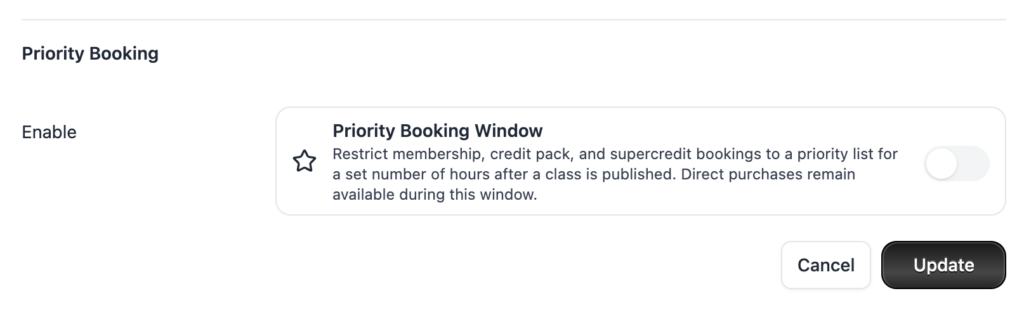
If you run popular classes that fill up fast, you know the drill — spots are gone in seconds and your most loyal members miss out. Priority Booking gives your best clients a head start by reserving a booking window just for them before the class opens up to everyone else.
You choose which clients get priority, how long the window lasts, and which schedules it applies to. It’s a great way to reward loyalty and keep your regulars coming back.
How it works
When a class opening is created for a schedule with priority booking enabled, a priority window kicks in. During that window, only clients on your priority list can book. Once the window expires, the class opens up to all clients as normal.
The priority window starts when the opening is created — so if you’ve set up a class release time, the window begins at that release time rather than in the middle of the night. We’d recommend pairing priority booking with a class release time so your priority clients get the most out of their head start.
Who gets priority?
You have three ways to define your priority list, and you can mix and match:
Individual clients — hand-pick specific clients who should get early access
Membership plans — any client with an active membership on a selected plan gets priority
Client tags — any client with a selected tag gets priority
A client only needs to match one of these to be on the priority list. For example, if you select a “VIP” tag and an “Unlimited” membership plan, any client who has either the tag or an active membership on that plan will get priority access.
Setting up Priority Booking
Priority booking is configured per schedule, so you can offer it on your high-demand classes without affecting the rest.
When creating a new schedule
1. In Clovo Studio, go to Setup > Schedule.
2. Click Add schedule.
3. Fill in the class, day, time, and other details as usual.
4. In the Priority Booking section, toggle Enable Priority Booking on.
5. Set the Priority window (hours) — this is how long the priority-only period lasts, from 1 to 168 hours (7 days).
6. Select your priority Clients, Plans, and/or Tags.
7. Save the schedule.
On an existing schedule
1. Go to Setup > Schedule and click on the schedule you’d like to update.
2. Click Edit.
3. Toggle Enable Priority Booking on and configure the window and priority list.
4. Save your changes.
Changes to the priority list or window duration only apply to future openings. Any classes that have already been opened keep their original priority window timing.
What your clients see
During the priority window, clients who aren’t on the priority list won’t be able to book the class. They’ll see that the class is in a priority booking window and when the window ends, so they know exactly when they can jump in.
Once the window expires, the class opens up and anyone can book as normal — first in, best dressed.
Pairing with Class Release Time
Priority booking works best when paired with a class release time. Without a release time, openings are created whenever our scheduler runs (every 30 minutes), which could be at any hour. The priority window starts from that moment, which might mean it’s ticking away overnight when nobody’s booking.
By setting a release time (e.g. 7:00am), you ensure the priority window starts when your clients are actually online and ready to book.
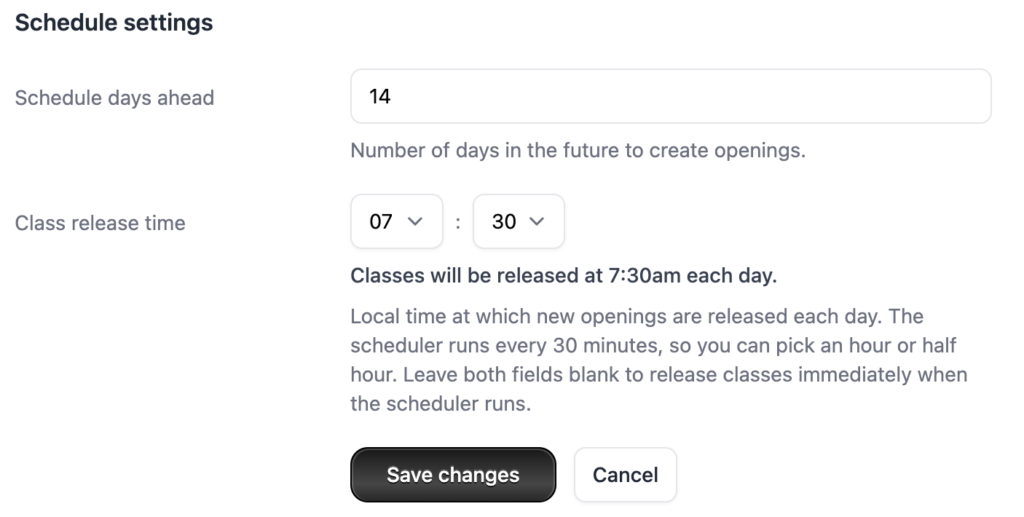
To set a class release time, head to Setup > Account and scroll to the Schedule settings section.
FAQs
Can I have different priority windows for different classes?
Yes. Priority booking is set per schedule, so you can have a 24-hour window on your Saturday morning Pilates and a 4-hour window on your Tuesday evening class — or no priority booking at all on others.
What happens if I don’t select any priority clients, plans, or tags?
If you enable priority booking but don’t add anyone to the priority list, nobody will be able to book during the window. Make sure you’ve selected at least some clients, plans, or tags.
Do one-off purchases bypass the priority window?
Yes. If a client is purchasing a class directly (a one-off payment rather than using a membership or credit pack), the priority window is bypassed. This means you won’t miss out on revenue from walk-in or casual clients during the priority period.
Can staff still book clients during the priority window?
Yes. When you book a client into a class from the dashboard, the priority window is bypassed. This gives you the flexibility to manage bookings manually when needed.
I edited my schedule’s priority settings — why didn’t existing classes change?
By design, existing openings keep their original priority window. This avoids changing the rules on clients who may have already seen or planned around the original timing. Your changes will apply to all future openings generated from that schedule.
Does priority booking work with waitlists?
Yes. Priority booking and waitlists are independent features that can both be active on the same class. The priority window controls who can book during the initial window, while the waitlist manages what happens when a class is full.
When you add classes to your schedule, Clovo automatically generates openings for your clients to book into. By default, those openings appear the moment our scheduler runs — which might be the middle of the night or some other time that doesn’t suit your studio.
Class Release Time lets you choose a specific time of day when new openings are released to your clients. This means everyone gets a fair shot at booking, and you get to decide when that window opens.
This works hand-in-hand with the Schedule Days Ahead setting, which controls how far into the future your openings are generated.
How it works
Our scheduler runs every 30 minutes in the background, generating openings based on your schedule. Without a release time set, new openings appear whenever the scheduler happens to run.
When you set a release time, the scheduler holds off on releasing the next day’s batch of openings until your chosen time. So if you’ve set your release time to 7:00am, your clients won’t see new openings appear until after 7:00am each day in your studio’s local timezone.
This is particularly useful if you offer priority booking — it means the priority window starts at a time when your members are actually awake and ready to book, rather than burning through overnight.
Setting up Class Release Time
1. In Clovo Studio, go to Setup > Account.
2. Scroll down to the Schedule settings section.
3. Under Class release time, select an hour and minute from the dropdown menus.
4. Click Save schedule settings.
You can only choose times on the hour or half hour (e.g. 7:00am, 7:30am, 8:00am). This matches the frequency our scheduler runs, so there’s no misleading lag between the time you pick and when classes actually appear.
A live preview will show you exactly when classes will be released based on your selection.
Changing Schedule Days Ahead
While you’re in the schedule settings, you can also adjust how many days into the future your openings are generated.
1. In the Schedule settings section, find Schedule days ahead.
2. Enter a number between 1 and 30.
3. Click Save schedule settings.
The default is 14 days. If you set this to 7, your clients will only ever see the next week of classes. Set it to 30 and they’ll be able to book up to a month out.
Clearing the release time
If you’d like to go back to the default behaviour where classes are released as soon as the scheduler runs, simply clear both the hour and minute dropdowns so they’re blank, then save.
FAQs
Does changing the release time affect classes that are already open?
No. Any openings that have already been generated and are visible to your clients stay as they are. The release time only affects when new openings appear going forward.
What happens if I don’t set a release time?
Classes are released as soon as the scheduler runs, which happens every 30 minutes. This is how Clovo works out of the box — you only need to set a release time if you want more control over when new openings appear.
Does the release time use my studio’s timezone?
Yes. The time you set is based on the timezone configured for your studio in your business address settings.
I changed my schedule days ahead — why don’t I see more classes yet?
The scheduler runs every 30 minutes, so it may take up to 30 minutes for new openings to appear after you change this setting. If you’ve also set a release time, the new openings won’t appear until after that time.
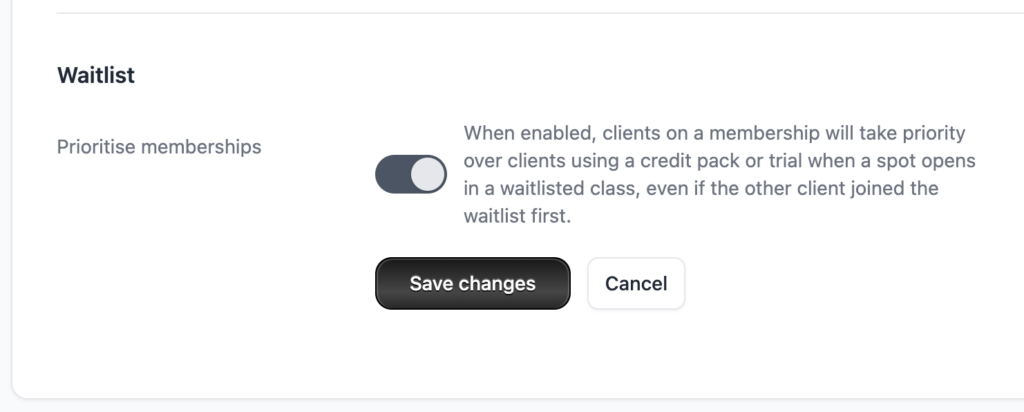
Your most loyal clients — the ones who’ve committed to a membership — can now be given first dibs when a spot opens up on the waitlist over credit pack and trial clients.
What is Membership Waitlist Priority?
When a spot opens in a waitlisted class, Clovo normally fills it on a first-come, first-served basis. That’s fair enough, but it means a client who bought a casual credit pack five minutes ago gets treated the same as the member who’s been training with you every week for two years.
Membership Waitlist Priority changes that. When enabled, clients on a membership automatically jump ahead of clients using a credit pack or trial — even if the credit pack client joined the waitlist first.
Members still compete with other members on a first-come, first-served basis, and credit pack and trial clients still compete with each other the same way. The only change is that members get processed first when a spot opens up.
Why it matters
Memberships are the backbone of your revenue. Rewarding that commitment with a better waitlist experience is a small thing that sends a big signal — “we value you being here.”
It also gives fence-sitters one more reason to lock in a membership instead of rolling with casual packs. It’s great marketing for your memberships.
How to turn it on
Head to Settings in your dashboard
Scroll down to the Waitlist section
Toggle on Prioritise memberships
Hit Save
That’s it. The setting takes effect immediately for all future waitlist processing.
How it works in more detail
Say you’ve got a full class with three people on the waitlist:
Position
Client
Plan type
Joined waitlist
1st
Sarah
Credit pack
9:00 AM
2nd
James
Membership
9:05 AM
3rd
Mia
Trial
9:10 AM
Without priority enabled, Sarah gets the spot — she joined first.
With priority enabled, James gets the spot. He’s the only member on the waitlist, so he moves to the front regardless of join time. If another spot opens, Sarah gets it next (credit pack clients are still ordered by join time among themselves).
Good to know
Only kicks in when there’s competition. If the class has space, everyone books in normally — no waitlist, no priority needed.
Members vs members stays fair. Two members on the same waitlist are still ordered by who joined first. Priority only comes into play between membership clients and credit pack or trial clients.
Trials are treated like credit packs. Both are deprioritised equally when the setting is on.
Frequently asked questions
Will my clients know they’ve been bumped? No. The waitlist experience from the client’s perspective doesn’t change — they still get notified when they get a spot. There’s no visible indicator of priority ordering.
Can I turn it off again? Yep, just flip the toggle back. It takes effect straight away and your waitlists go back to pure first-come, first-served.
Does this affect clients already on a waitlist? Yes. Priority is applied at the time a spot becomes available, not when the client joins the waitlist. So if you enable it while people are already waitlisted, the new ordering applies next time a spot opens.
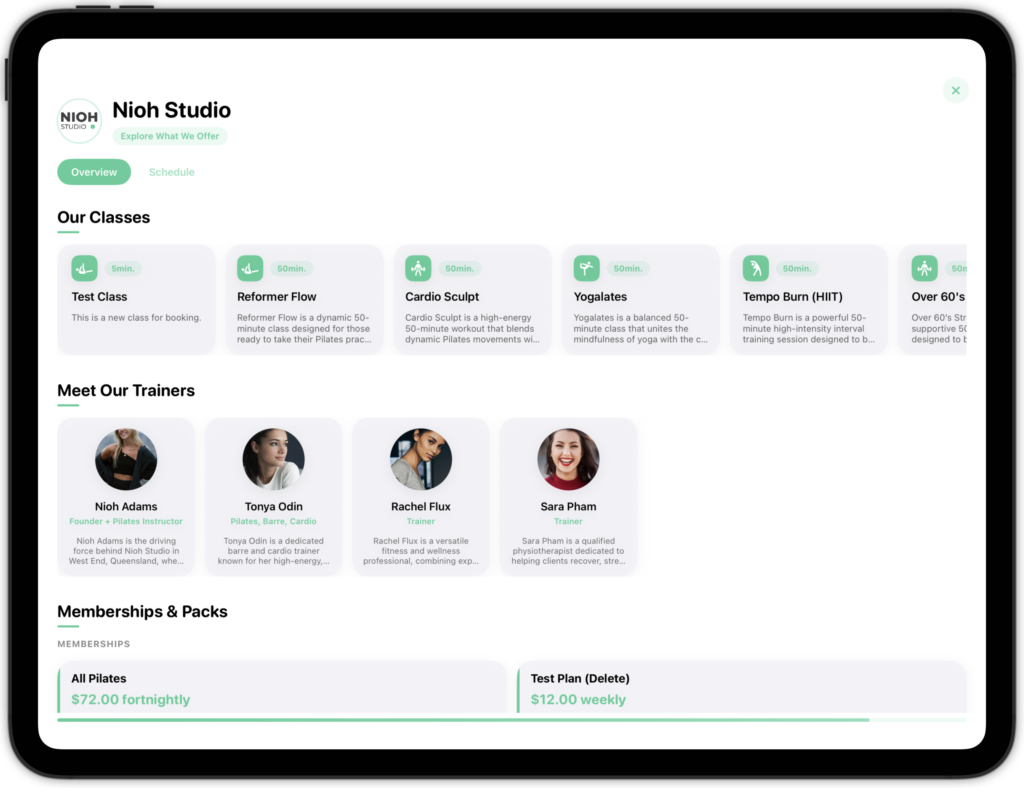
Built into Clovo Kiosk, Overview is designed for those moments when someone walks in curious, the instructor is mid-class, or your team wants a simple way to walk a potential customer through everything the studio offers. Instead of relying on memory or rushing through a conversation, staff can use Overview to guide people through the full studio experience in one place.
Why it matters
Overview is more than an information screen. It is a sales tool.
It helps studios confidently show off what makes them special, whether that is the variety of classes on offer, the personalities behind the brand, the membership options available, or the products members can buy in-studio.
For walk-ins, it creates a smoother first impression while they wait. For staff, it makes it easier to present the studio clearly and consistently. For instructors, it helps turn a casual enquiry into a more informed conversation.
What people can explore
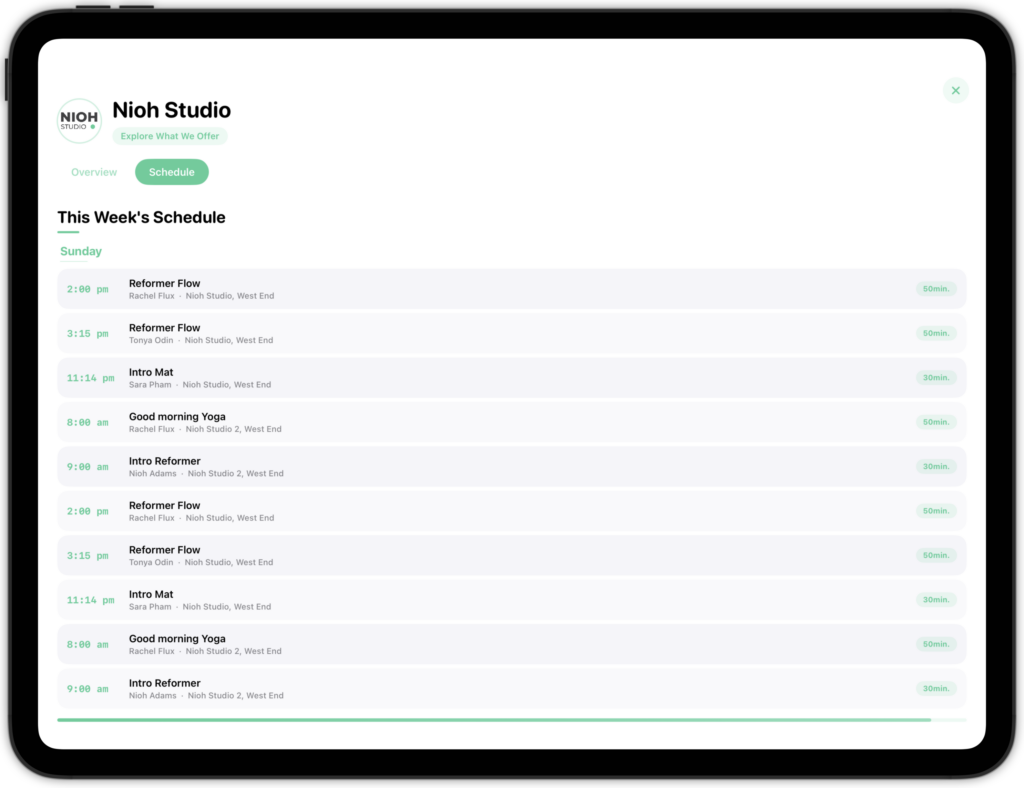
Overview gives potential customers a simple, visual way to browse the studio offering, including:
Class types and descriptions
Instructor profiles
Memberships
Packs
The member shop
Your weekly schedule
It is all presented in a clean, branded experience that helps people understand the studio without feeling overloaded.
A better experience for walk-ins
When someone walks in off the street, they often want a quick answer to a few simple questions:
What kind of classes do you run?
Who are your trainers?
What does it cost?
What can I book?
What is on this week?
Overview helps answer those questions visually, even if the team is busy. That means a walk-in can stay engaged with the brand instead of standing at reception waiting with no context.
A useful tool for staff
Overview also works beautifully as a guided sales conversation.
Staff can use it to step through the studio offering with confidence, making sure they do not miss:
The range of classes available
The trainers behind the experience
The memberships and packs that suit different goals
The retail products available in-studio
The schedule a new customer could join
It gives every team member a consistent way to present the business, whether they are experienced at sales or not.
What makes it feel premium
Clovo Kiosk Overview is designed to feel like part of the studio experience, not just another admin screen.
It includes:
Studio branding with name and logo
A clean full-screen layout
Dedicated Overview and Schedule views
Easy browsing for both self-guided visitors and staff-led conversations
The result is something that feels closer to a digital showroom than a traditional kiosk menu.
Good to know
Overview is part of Clovo Kiosk and can be opened from the kiosk experience via View our offering.
It is ideal for:
Walk-ins waiting at reception
Instructors or staff showing a potential customer around
Helping new visitors quickly understand the studio
Keeping key information visible in one place
If you want, I can also turn this into a shorter website-style version or a more help-centre-style version next.
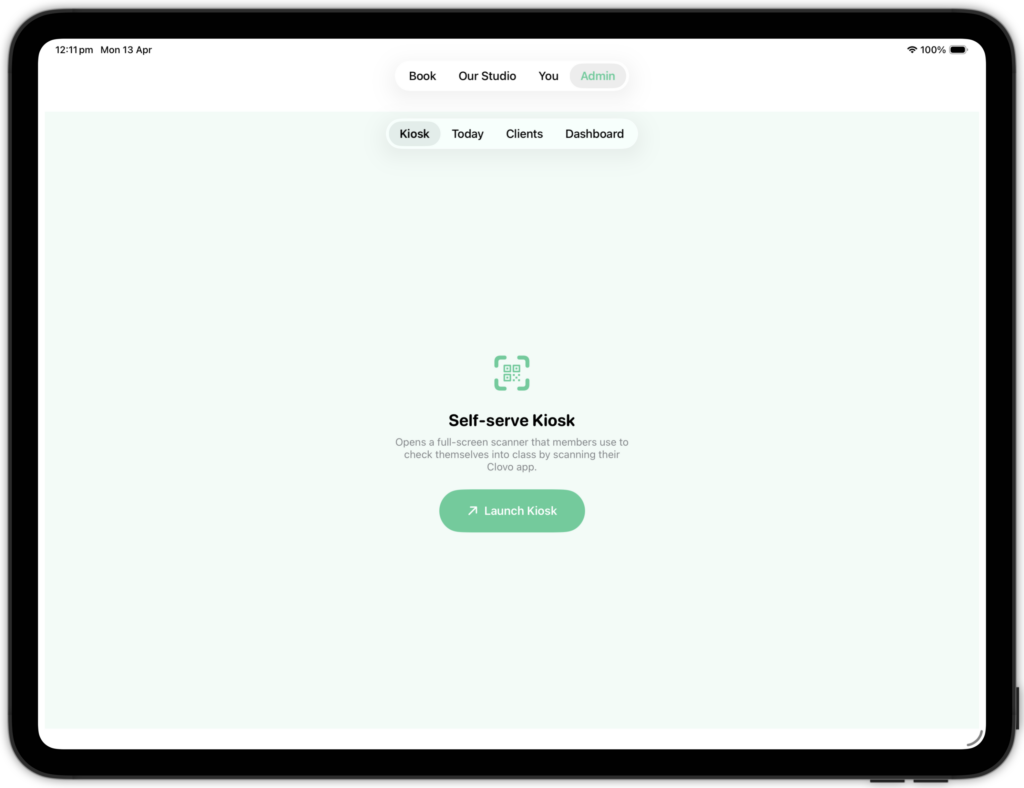
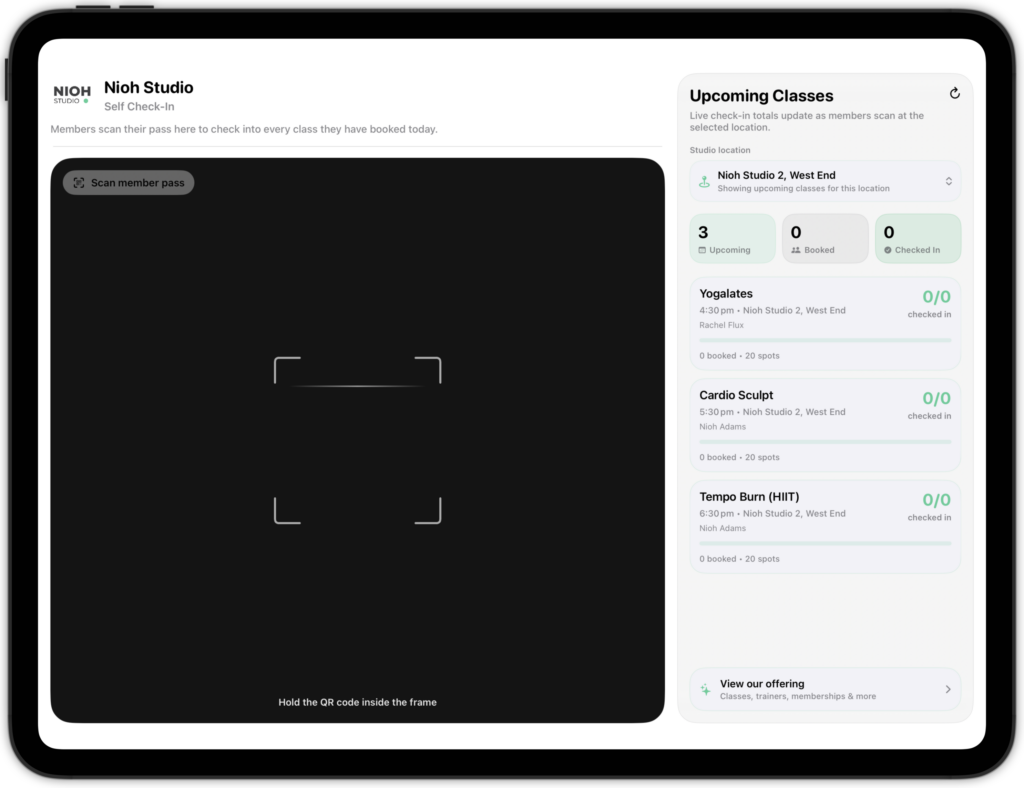
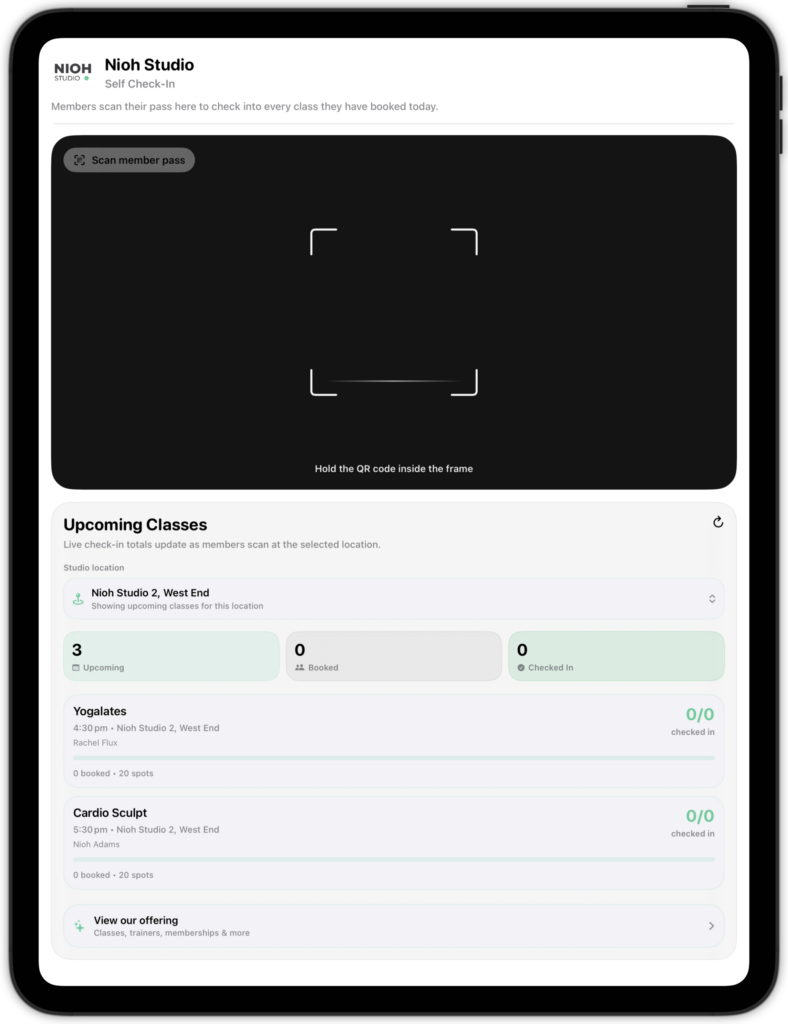
Self-serve Kiosk allows you to turn an iPad (or iPhone, in a pinch) into a front desk check-in station. Members can simply scan their self check-in QR code from the Clovo app as they arrive, and the kiosk will handle the rest.
How Clovo Self-serve Kiosk works
When a member presents their self check-in pass, the kiosk scans the QR code and automatically checks them into all of their eligible bookings for that day.
The screen also displays all upcoming classes at the location as well as some fun stats. Clients can change the studio location if needed, but once the iPad has been entered into Self-serve Kiosk mode, it cannot be exited, so that clients cannot access your app logged in as an admin.
Before you start
Make sure:
You are signed in as with an owner or staff account
Camera access is enabled
The device has an active internet connection
How to open Self-serve Kiosk
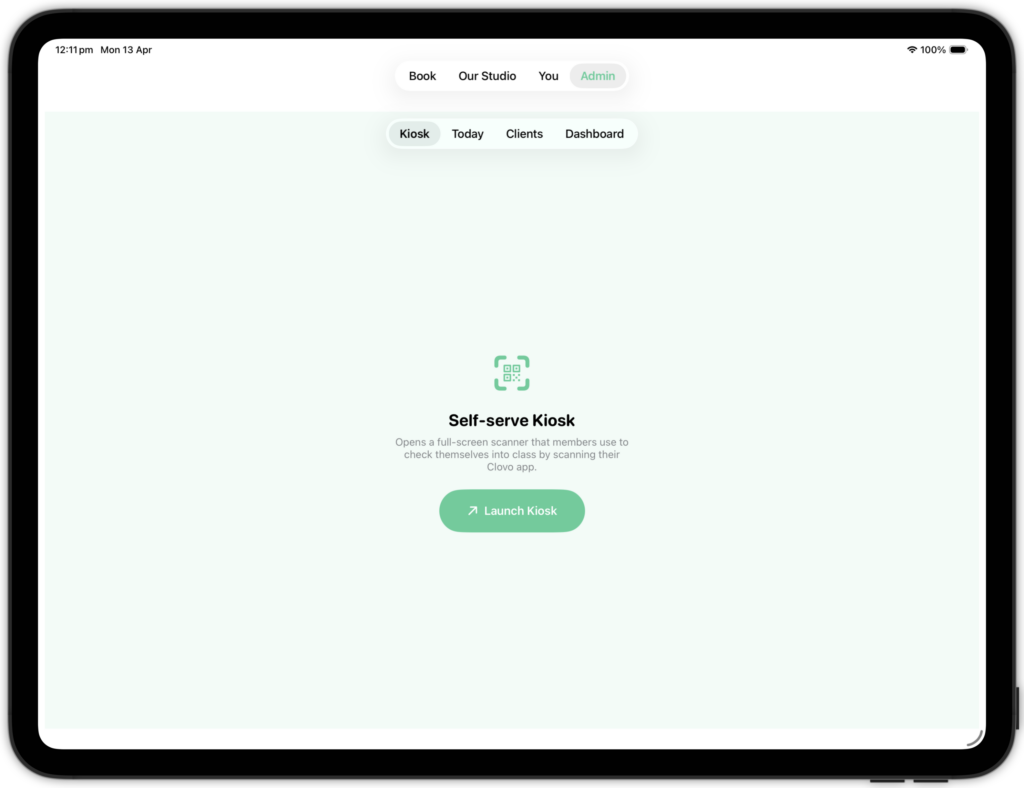
Open the admin panel in the Clovo app, then tap “Self-serve Kiosk”.
The device will switch into a full-screen kiosk mode. If prompted, allow camera access. Once open, the kiosk is ready to scan member passes.
How members use it
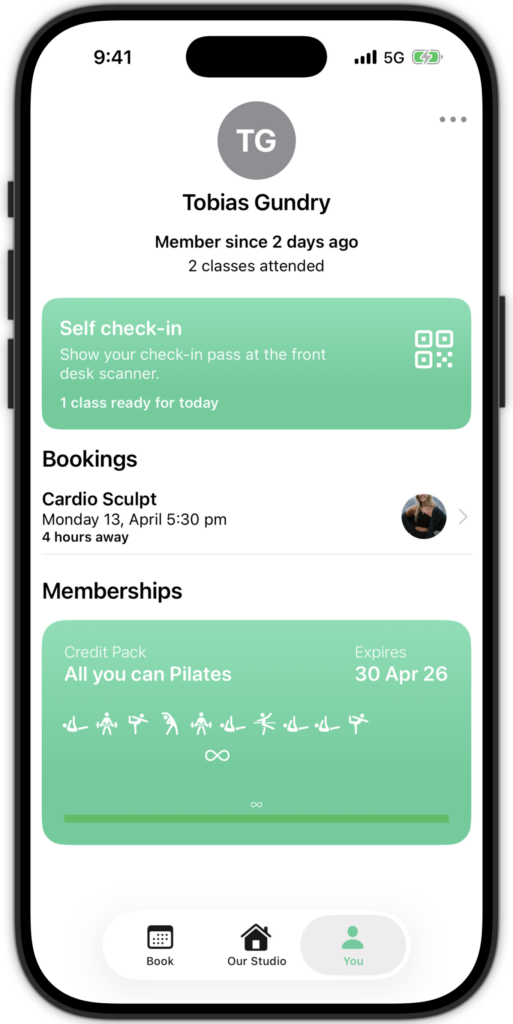
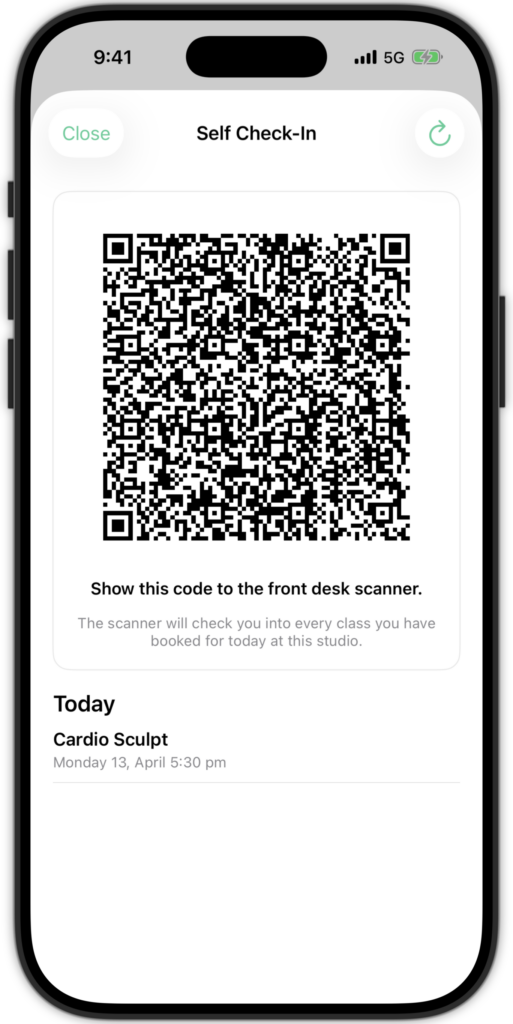
Members open their Self Check-In pass in the Clovo app and present the QR code to the device. Members will automatically be prompted to open their self check-in pass when accessing their account screen on a day they have bookings.
When scanned, the kiosk checks them into all eligible bookings for that day at the current studio.
What staff will see
After each scan, a result card appears showing what happened:
Checked in: all eligible classes were successfully checked in
Already checked in: all bookings were already marked as attended
Check-in partly complete: some bookings were checked in, but others were already completed or couldn’t be processed
Check-in failed: no eligible bookings could be checked in
The result card may also list the specific classes affected.
Studio location filter
The Studio location menu controls which classes and check-in totals are displayed on the screen.
This only affects the live class list. A member’s check-in pass will still apply to all eligible bookings for today at the current studio.
Troubleshooting
Camera access is off If camera access is disabled, tap “Open Settings”, enable camera access for Clovo, then return to the app and reopen the kiosk if needed.
Couldn’t load today’s roster Check the device’s internet connection, tap refresh, and confirm you are signed into the correct location.
Pass not recognised This usually means the QR code couldn’t be read or isn’t a valid Clovo pass.
Try:
Increasing the member’s screen brightness
Positioning the QR code fully within the scan frame
Asking the member to refresh their bookings and reopen their pass
Unsupported pass The pass format is outdated. Ask the member to update or refresh the app and reopen their self check-in pass.
Wrong studio The pass belongs to a different studio. Ask the member to switch studios in the app and try again.
Pass isn’t for today Self-serve Kiosk only works for same-day bookings. Confirm the member is booked into a class today.
Duplicate scans If the same pass is scanned twice in quick succession, the second scan may be ignored. Wait a few seconds before scanning again.
Portrait or Landscape
Clovo Kiosk supports both orientations. Choose the one that works best for your space!
This article explains what happens when a membership renewal payment fails, who is notified, where to find failed payments in Clovo, and what actions your team can take to recover them.
What happens when a renewal payment fails
When Stripe reports that a renewal invoice payment has failed, Clovo automatically steps in to make sure both your team and the client are aware, and that recovery can happen quickly.
The payment is marked as an unresolved failed renewal, making it visible across the platform.
The client is sent a payment recovery email with a link to complete the payment.
Relevant staff members are notified so they can follow up if needed.
The failed payment appears in key areas of the product to prompt action.
Client notification
The client receives an email prompting them to take action on their payment. This email typically includes the payment amount, the membership or plan name, and the reason for the failure if Stripe provides one.
If available, the email will also show the next automatic retry date and includes a Pay now button that links directly to Stripe’s hosted payment page. This allows the client to resolve the issue immediately without waiting for a retry.
Staff notification
Staff members responsible for managing payments are also notified. This usually includes owners, admins, and finance users.
The notification may include the client’s name, the affected membership or product, the failure reason, and the next retry attempt if one is scheduled. In some cases, a direct payment link is also provided to make it easier to assist the client.
Where to find failed payments in Clovo
Failed renewal payments are surfaced in multiple places to make sure they are not missed during day-to-day operations.
On the dashboard, a Failed Payments card appears when there are unresolved renewal issues. This gives a quick overview and links directly to the full list.
The main workflow lives in the Failed Payments queue. This is where you’ll see all unresolved renewal failures across your studio, including details like the client, plan, failure reason, next retry date, and available recovery actions.
Failed payments also appear within the client profile, the membership page, and related payment records. These contextual indicators help staff spot issues while working with clients and take action without needing to switch screens.
What actions staff can take
When a payment fails, the first step is to review the details. Check the client name, the affected membership, the failure reason, and whether Stripe has scheduled another retry. This helps you decide whether to wait or act immediately.
The primary action is sending a payment request. When you do this, Clovo confirms the payment is still unresolved, ensures a valid payment link exists, and sends a new recovery email to the client. It also records the action so there is a clear audit trail.
If a payment link already exists, you can open it directly using the Pay now link. This is especially useful when assisting a client in real time or confirming that the link is working correctly.
In many cases, reaching out to the client directly is also worthwhile. Let them know the payment has failed, that it may retry automatically, and that they can resolve it immediately using the payment link. If needed, they may also need to update their payment method.
What happens when the payment is recovered
Once the client completes the payment, or Stripe successfully retries it, the system updates automatically.
The payment is no longer treated as unresolved, it is removed from the failed payments queue, and any related alerts or banners disappear. There is no need for manual cleanup, as the system keeps the list up to date.
Common questions
If you cannot see a failed payment in the queue, it is likely because the queue only shows unresolved renewal failures. It does not include first-time payment failures, one-off purchases, credit packs, or payments that have already been recovered.
If a failed payment disappears, it usually means the issue has been resolved, either because the client paid manually or Stripe successfully retried the payment.
If the dashboard card is not visible, it may be because there are no current failures, your role does not include access to that view, or you are not on a dashboard where the card is shown. The Failed Payments queue remains the primary place to manage these issues.
When a payment fails, the client is always notified by email. Internal notifications are available to owners, admins, and finance users. If a staff member resends a payment request, the client receives another email and the action is recorded for reference.
Gift purchases let your existing clients buy a credit pack for someone else. Once enabled, your public landing pages will show a Purchase as gift option for that pack.
Before you start
Gift purchases are available for credit packs only.
To use gift purchases, make sure:
your studio has Stripe connected
your landing page is enabled
the pack you want to sell is active
you enable gift purchases on each pack you want to offer
How to enable gift purchases
Go to Services > Credit Packs.
Create a new credit pack or open an existing one to edit it.
In the pack settings, turn on Allow gift purchase.
Save your changes.
That’s it. Once saved, that pack can be purchased as a gift.
What your clients will see
When gift purchases are enabled for a pack:
a Purchase as gift button appears alongside the normal purchase option on your landing pages
the purchaser must be an existing user and must sign in first
the purchaser enters the recipient’s first name, last name, and email address
the purchaser completes payment through Stripe
What happens after purchase
When a gift is purchased:
your studio staff are notified
the purchaser is notified
the gift recipient is notified
the purchaser email includes the purchase details and a Stripe receipt link
the recipient receives a secure claim link by email
The gift is not activated immediately. It stays unclaimed until the recipient completes the claim process.
How gift claiming works
The recipient claims the gift through a secure email link.
If they already have an account, they sign in with the same email address the gift was sent to.
If they are new, they complete registration first.
During registration they’ll be asked to add required details such as phone number and accept studio terms and waivers.
Once completed, the gifted pack membership is created and the gift is marked as claimed.
When the gift is claimed:
your studio staff are notified again
the purchaser is notified
the recipient is notified
How gifts appear in the dashboard
Once claimed, the membership is linked back to the gift purchase for tracking.
In the dashboard, gifted memberships are marked visually with a gift chip using a present icon.
Important notes
Only packs with Allow gift purchase turned on can be bought as gifts.
Recurring memberships and trials cannot be sold as gifts.
Clients cannot use the gift flow to buy for themselves.
The gift must be claimed using the email address it was purchased for.
Troubleshooting
If Purchase as gift is not showing:
check that the product is a credit pack, not a recurring membership or trial
confirm Allow gift purchase is turned on for that pack
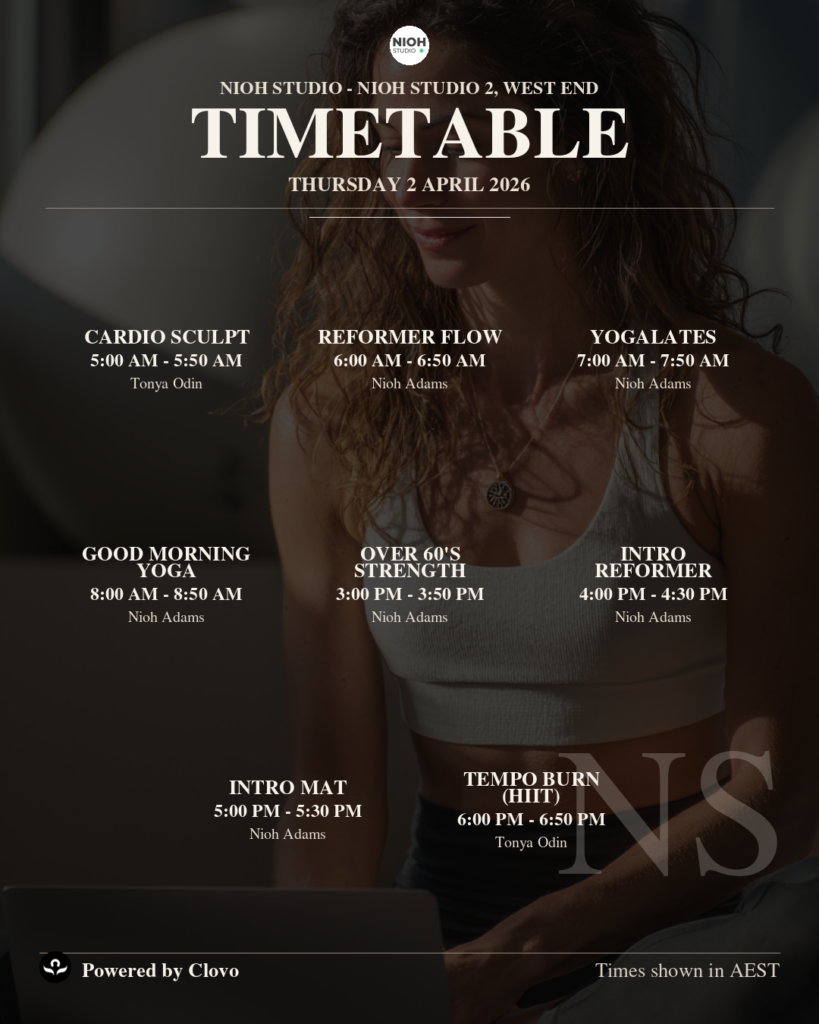
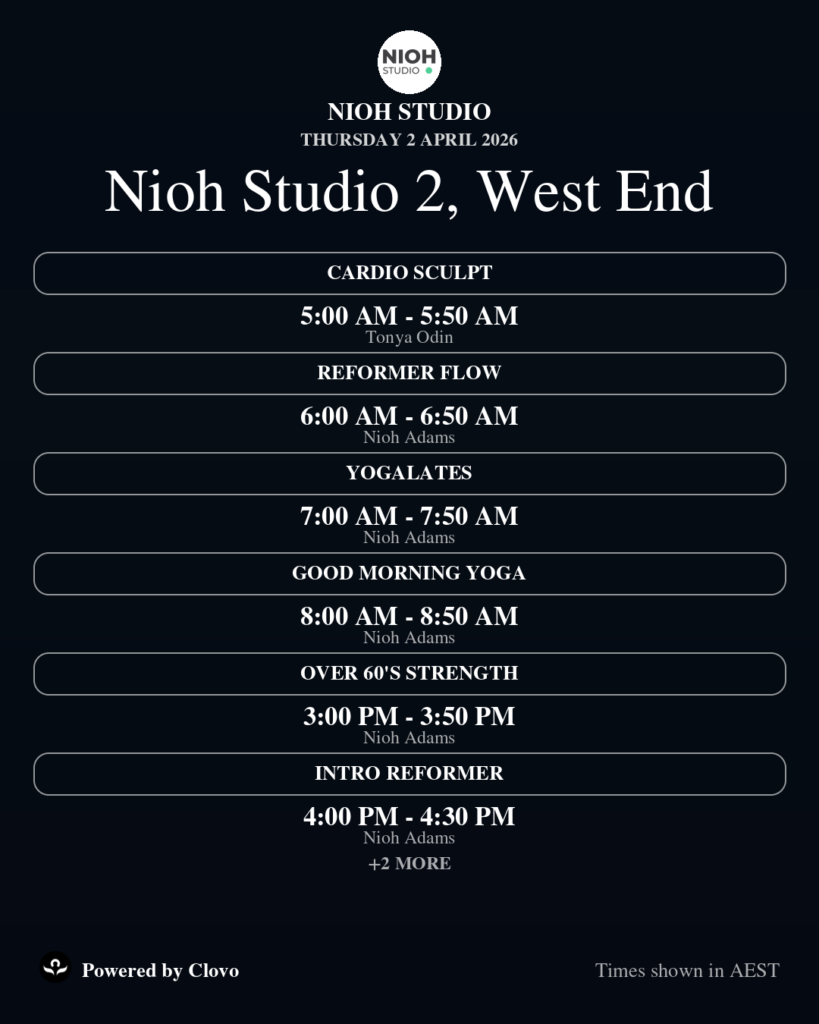
The Social Timetable tool lets staff and owners create polished timetable graphics sized for social media. Images are generated in portrait format at 1080 x 1350 and can be created for a single day or for a full week. Class times are always shown in your studio’s timezone.
The below graphic was generated entirely in Clovo with no external edits.
Generate your timetable
The generator creates a shareable timetable image using your current or future openings for a selected location. You can create an image for a single day or a week, preview it instantly, and download the final PNG when you are happy with the design.
The graphic can include your studio logo, branding colours, optional background image, trainer details, and different layout styles depending on the look you want.
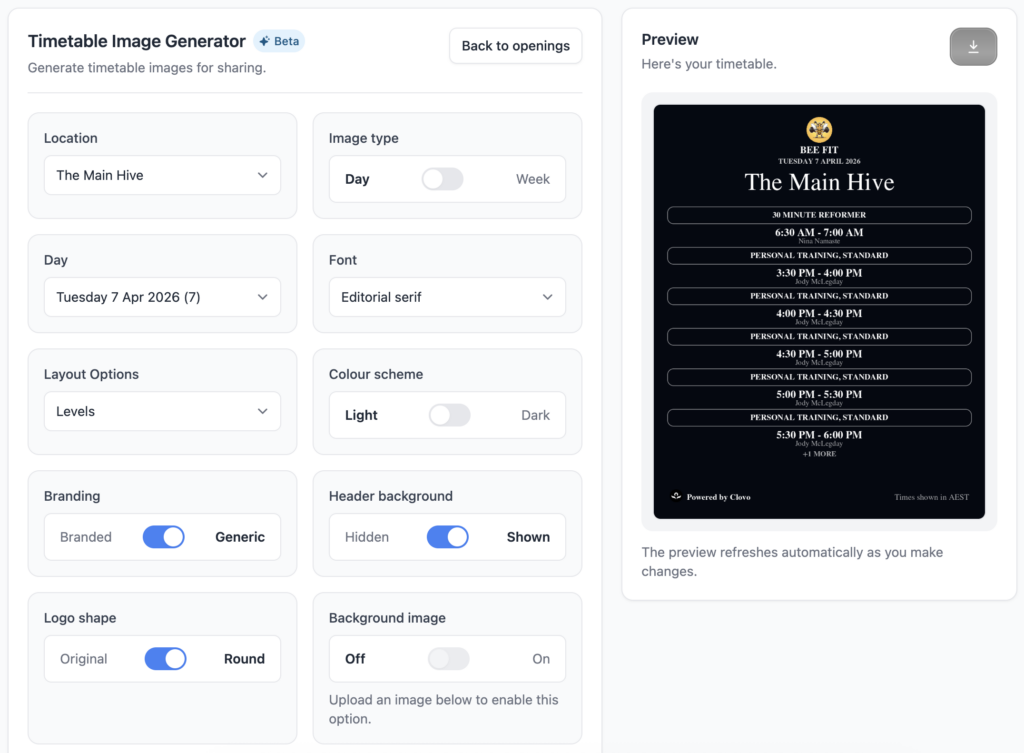
How to create a timetable image
Open Upcoming Classes > Share Timetable. Choose the location you want to use, then select whether you want a day or week view. Pick the day or week starting date from the available options.
You can then customise the image using the available design controls. These include font choice, light or dark colour scheme, branded or generic styling, layout style, header background, background image, and logo shape. If you turn on the round logo option, your studio logo will be masked into a circular shape in the final image.
As you make changes, the preview updates automatically. When the image looks right, use the download icon to save the PNG.
Quick date shortcuts
To speed things up, the generator includes shortcut options for Today, Tomorrow, and Current week. These use the studio timezone when working out the correct day or week.
How times are shown
All class times in the image are converted into the studio timezone, even if the selected location uses a different timezone. The footer also shows the timezone abbreviation, such as AEST or AEDT.
Branding and logo options
Branded mode uses your studio’s primary and secondary colours. Generic mode uses a neutral black, white, and grey palette. If your studio has a logo, it will be included in the image. You can also choose whether the logo keeps its original shape or is displayed as a circle using the Logo shape toggle.
If your studio does not have a logo, the image will still generate using a fallback badge.
Background images
You can upload a background image to give the graphic a more promotional feel. When enabled, the background fills the full image area and is automatically sized to cover the canvas. If needed, you can remove the background image and return to a clean design.
Design tips
For a more polished promotional result, choose a layout that suits the amount of content you are sharing. Day images work best when highlighting a specific day’s classes, while week images are useful for giving a full overview.
Light mode often works well for a clean, premium look. Dark mode can be more striking when paired with a strong logo or a photographic background. Generic styling is useful when you want something minimal, while branded styling is better when you want the image to feel clearly connected to your studio.
Troubleshooting
If you cannot see a day or week you expect, it usually means there are no eligible current or future openings available for that location and date range. Cancelled openings are not included.
If the preview is not showing the logo correctly, try switching the Logo shape setting or checking that your studio logo has been uploaded properly in branding settings.
If a background image does not appear, make sure it has been uploaded first and that the background image option is turned on.
If you see fewer classes than expected, try a different layout or a week view, as some layouts are more compact than others.