Author: user

View current subscribers of a membership plan

Keeping track of your membership plan subscribers is essential for managing your studio effectively. Clovo Studio makes it easy to see exactly who is subscribed to any given plan, helping you understand plan popularity and manage your revenue.

How to view subscribers

  1. In Clovo Studio, go to Products.
  2. Find the membership plan you want to check.
  3. Click into the plan details.
  4. The Subscribers section shows all clients currently on this plan.

What you can see

For each subscriber, you can view:

  • Client name — click through to their full profile
  • Subscription status — whether the membership is active, paused, or pending cancellation
  • Billing information — next billing date and payment status

Why this is useful

  • Revenue tracking — quickly see how many active subscribers you have on each plan
  • Plan comparison — identify which plans are most popular and which might need adjusting
  • Client management — easily find and reach out to all clients on a specific plan
  • Churn monitoring — spot paused or cancelling memberships early so you can take action

Cancel upcoming classes that have already been scheduled

Sometimes plans change, and you may need to cancel a scheduled class opening. Clovo puts cancellations on autopilot — notifying all booked clients of the change, making any appropriate refunds or credit adjustments, and updating your timetable automatically.

How to cancel a class opening

  1. In Clovo Studio, go to the Openings page.
  2. Find the class you want to cancel and click on it to open the detail view.
  3. Click the Cancel button (shown with a red X icon).
  4. Confirm the cancellation.

What happens when you cancel

  • Clients are notified — all clients who had booked the class will receive a cancellation notification via email and push notification
  • Credits are restored — if clients used credit pack credits to book, those credits are returned to their pack
  • Timetable is updated — the class is removed from your public timetable and the Clovo app

Cancelling vs. deleting a schedule entry

Cancelling a class opening removes a single instance of a class. It does not affect your underlying schedule, so the class will still appear on future dates. If you need to permanently remove a recurring class, you should edit or delete the schedule entry instead. See Schedules in Clovo for more information.

If your studio is closing temporarily (e.g. for holidays), consider using the Closures feature under Operations rather than cancelling individual classes.

Credit Packs in Clovo

Credit packs let clients book into classes with your studio without committing to a recurring subscription.

Credit packs are prepaid credits for selected classes to be used within a specified period with your studio. Unlike memberships which renew at set intervals, credit packs don’t renew or automatically refill. Which makes them a great option for casual members who may not be able to commit to the regular schedule that memberships cater for.

Packs are also a great way for clients who already have a membership subscription to buy additional services, such as adding private one-on-one classes in addition to their weekly classes membership.

Creating a Credit Pack in Clovo

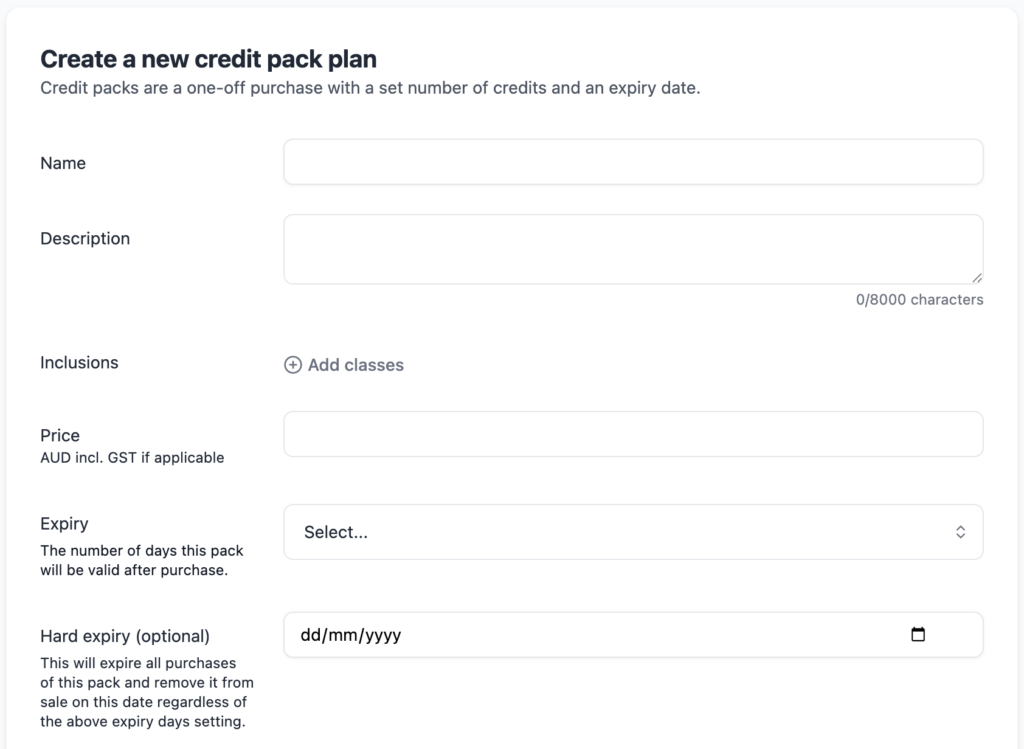
To create a credit pack in Clovo, from your studio dash at https://studio.clovo.au, expand the ‘Products’ dropdown in the lefthand side navigation menu, click into ‘Packs’, then ‘Add Pack’.

Basic Details

Give your pack a name and description, and set a price including GST if applicable.

Expiry

Set when new purchases of this pack should expire. The expiry is calculated starting from the date of purchase. If needed, you can easily extend the expiry date on a per-client basis following purchase, where needed at your discretion.

You can optionally set a hard expiry date. This gives you an option to expire all credit packs of this type on a given date, rather than a relative number of days from the purchase date. This is a great option for special deals such as opening specials. If you set hard expiry, the pack will also be removed from sale on the expiry date, in addition to all purchases being expired.

Setting inclusions

Credit packs let you sell prepaid credits to clients that can be used to book classes at your studio. Which classes and how many of each is up to you.

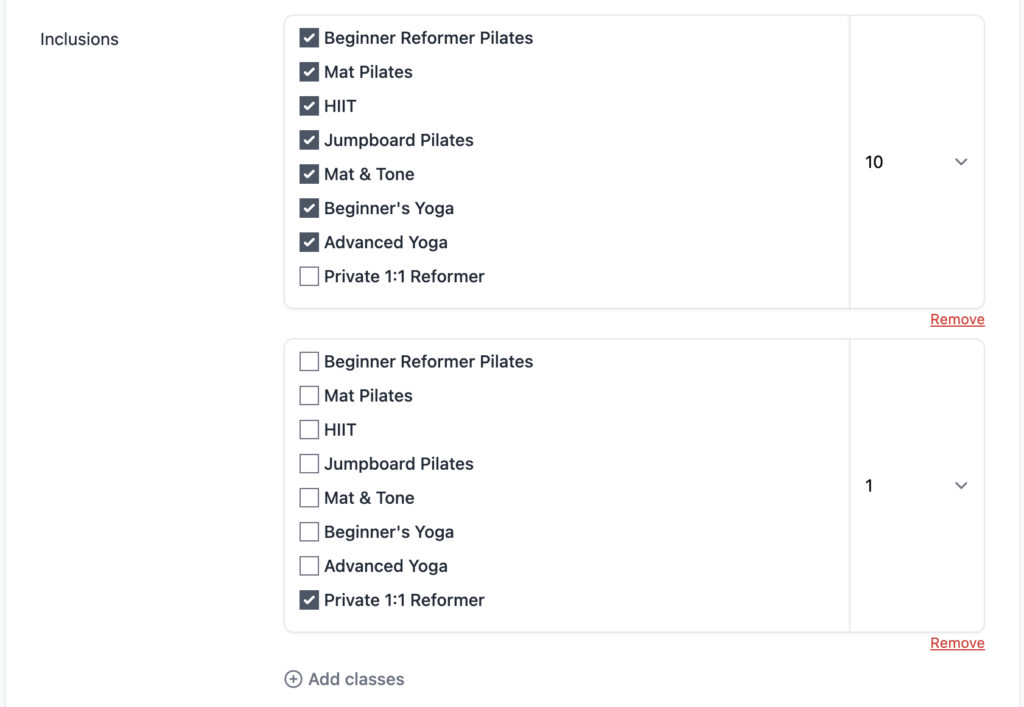
To set these inclusions click ‘Add Classes’ on the create or edit screen. Class inclusions are added in groups that let you set how many of each class on that row is included.

For example, if you want to create a pack that gives 10 credits to attend any of your classes, you would create a single group, tick all classes, and set the quantity to 10.

However, if you wanted to also include a private one-on-one reformer session to the pack in addition to the 10 classes, but restricting bookings of that class type to a single class, you would then add an additional group of inclusions, tick only the ‘Private 1:1 Reformer’ class type, and set the quantity to 1.

With this configuration, your pack will now let your client book any 10 of your regular classes, but only 1 private one-on-one reformer class.

Credit Pack FAQs

Credit Pack Expiry

  • Credit packs expire the number of days from the purchase date that you specify or when all credits have been redeemed, whichever comes first.
  • You can extend the expiry date of a purchased credit pack.
  • Hard expiry sets a date that all packs of that type will expire regardless of purchase date. Packs with a hard expiry will also be removed from sale on that date.
  • Clients cannot book for classes past the expiry date of their pack.

Offer recurring memberships by creating a membership plan

Memberships are recurring subscriptions to services from your studio. They’re the ideal product for most studios to sell, depending on your business model, because they ensure a continuous revenue stream in addition to helping to build a community of familiar faces in your studio.

The alternative to memberships are credit packs, where users buy a one-off pack of credits which don’t automatically renew at expiry.

In this article we’ll get real geeky about memberships and the seemingly unlimited ways they can be configured in Clovo to allow you to offer the exact product offering your business needs.

Creating a Membership Plan

While logged into Clovo as an owner or admin:

  1. Go to Products > Plans:
  2. Click Add Plan
  3. Configure your plan:
    • Choose the duration of the billing period (e.g., fortnightly, monthly, quarterly, yearly).
    • Define the number of classes or sessions included in the membership.
  4. Customise Plan Details:
    • Add a description that highlights the features and benefits of the membership.
  5. Create

Benefits of offering Membership Plans

  • Retain Clients: Encourage clients to commit to your studio long-term with membership plans.
  • Increase Revenue: Offer discounts and incentives to attract more clients and boost revenue.
  • Build Community: Create a sense of belonging and community among your members.

How Membership Booking Windows and Allowances Work

If your membership includes a set number of classes, those classes are counted within booking windows. A class uses the allowance for the window it takes place in, not the day you booked it. This means you can book ahead, but each week or fortnight still has its own limit.

How booking windows work

  • Weekly memberships use Monday to Sunday windows.
  • Fortnightly memberships use 2-week windows that run Monday to Sunday across both weeks.
  • And so on for longer membership billing cycles.
  • You can book ahead into future windows.
  • Each class counts toward the window its class date falls in.
  • Unused classes do not move into the next window.

Your first membership period

If you join on a Monday, your membership is already aligned to the normal weekly or fortnightly pattern.

If you join part-way through the week, we do not expect you to use a full allowance in only a few days. Your first allowance is measured from the day you join until your first renewal date. After that, your membership follows the normal Monday-based booking windows.

This is designed to avoid the unfair situation where someone joins mid-week and only gets a few days to use a full allowance.

Example: Weekly membership

You have a weekly membership with 3 classes per week.

You join on Thursday 6 August.

Your first allowance covers the period from Thursday 6 August until your first renewal date. During that first joining period, you can use up to 3 classes. You are not limited to only the remaining few days of that calendar week.

Once your membership moves onto its regular cycle, classes are counted in Monday to Sunday windows.

For example:

  • If you already have 3 classes scheduled in one Monday to Sunday week, you cannot add a 4th class in that same week.
  • If you book a class today for next Tuesday, it uses next week’s allowance, not this week’s.
  • If you have used all 3 classes this week, you can still book classes that fall in the following week, as long as that next week still has allowance available.

Example: Fortnightly membership

You have a fortnightly membership with 6 classes every 2 weeks.

Once your membership is on its regular cycle, one booking window might run from Monday 4 May to Sunday 17 May. The next window would run from Monday 18 May to Sunday 31 May.

How Future Bookings Work on Memberships

If you book classes in a future booking window, those bookings are treated as credit bookings. This means they are held on the assumption that your membership will still be active when that future window arrives.

A credit booking does not mean an extra payment is taken at the time of booking. It simply means the booking is being reserved against a future membership allowance.

What a credit booking means

  • If you book a class in a future week or fortnight, it uses the allowance for the window the class takes place in.
  • That future booking is held in advance based on the expectation that your membership will renew as normal.
  • If your membership remains active, the booking stays in place and counts toward that future window’s allowance.

Example

You have a weekly membership with 3 classes per week.

If you already have classes booked for this week, you can still book a class for next Monday if next week still has allowance available. That booking is treated as a credit booking until that next membership window is reached.

What happens if you cancel your membership

If you cancel your membership, any credit bookings for classes that take place after your membership ends will be cancelled.

This is because those bookings were being held on the assumption that your membership would renew, and once you cancel, that is no longer the case.

What stays booked

Any bookings for classes that take place on or before your paid-through end date will remain booked.

Example

If you cancel on the 15th, but your membership stays active until the 18th because that is the date you have already paid up to:

  • A booking on the 17th stays booked
  • A booking on the 18th stays booked
  • A booking on the 19th or later will be cancelled if it was a credit booking

Why credit bookings are cancelled when a membership is cancelled

Studios often have limited spaces in class. When a membership has been cancelled, any future bookings that rely on a renewal are removed so those places can be made available to other clients.

If you want, I can also turn this into:

  • a shorter in-app help version
  • an FAQ version
  • a combined article that explains both booking windows and credit bookings together

This means:

  • You can book up to 6 classes between 4 May and 17 May.
  • If you already have 6 classes scheduled in that 2-week window, you cannot add a 7th class in the same window.
  • You can still book classes that fall between 18 May and 31 May, because those use the next fortnight’s allowance.

What you can and can’t book

You can:

  • Book ahead into future weeks or fortnights
  • Use the full allowance available in each booking window
  • Book across multiple windows, as long as each window stays within its own allowance

You can’t:

  • Book more classes than your membership includes in a single week or fortnight
  • Use next week’s or next fortnight’s allowance to add extra classes to the current window
  • Carry unused classes into another window unless your studio offers a separate rollover policy

Why a booking may be blocked

The most common reason is that the class falls in a week or fortnight where you have already used the full allowance, even if you made the booking weeks in advance.

How Future Bookings Work on Memberships

If you book classes in a future booking window, those bookings are treated as credit bookings. This means they are held on the assumption that your membership will still be active when that future window arrives.

A credit booking does not mean an extra payment is taken at the time of booking. It simply means the booking is being reserved against a future membership allowance.

What a credit booking means

  • If you book a class in a future week or fortnight, it uses the allowance for the window the class takes place in.
  • That future booking is held in advance based on the expectation that your membership will renew as normal.
  • If your membership remains active, the booking stays in place and counts toward that future window’s allowance.

Example

You have a weekly membership with 3 classes per week.

If you already have classes booked for this week, you can still book a class for next Monday if next week still has allowance available. That booking is treated as a credit booking until that next membership window is reached.

What happens if you cancel your membership

If you cancel your membership, any credit bookings for classes that take place after your membership ends will be cancelled.

This is because those bookings were being held on the assumption that your membership would renew, and once you cancel, that is no longer the case.

What stays booked

Any bookings for classes that take place on or before your paid-through end date will remain booked.

Example

If you cancel on the 15th, but your membership stays active until the 18th because that is the date you have already paid up to:

  • A booking on the 17th stays booked
  • A booking on the 18th stays booked
  • A booking on the 19th or later will be cancelled if it was a credit booking

Why credit bookings are cancelled when a membership is cancelled

Studios often have limited spaces in class. When a membership has been cancelled, any future bookings that rely on a renewal are removed so those places can be made available to other clients.

Showcase your studio’s talent with trainer profiles

Showcase your talented training staff with trainer profiles in Clovo Studio. These profiles not only give clients a glimpse into your team but also enhance their experience by highlighting the professionals behind the classes. Follow these steps to create engaging trainer profiles.

Step-by-Step Guide to Creating a Trainer Profile

  1. Navigate to Trainer Profiles:
    • In the dashboard, expend the ‘Setup’ menu and find ‘Profiles’.
  2. Add a New Trainer Profile:
    • Click on ‘Add Profile’ and enter the trainer’s name, professional title, and upload a profile photo.
  3. Write a Biography:
    • Include a short but informative biography that highlights the trainer’s expertise and personality.
  4. Save the Profile:
    • Once all details are added, click on ‘Save’ to create the trainer profile. The profile will now be published and visible in client apps.

Importance of Trainer Profiles

Trainer profiles serve as a powerful tool to:

  • Showcase talent: Highlight the expertise and skills of your training staff.
  • Build trust: Clients feel more connected and confident when they know the professionals behind the classes.
  • Personalise experience: Match clients with trainers based on their preferences and goals.

Flexibility of Trainer Profiles

It’s important to note that trainer profiles are not connected to user accounts. This allows studios to:

  • Decouple admin staff: Keep trainer profiles separate from admin roles if needed.
  • Maintain flexibility: Easily update and manage trainer profiles without affecting other aspects of the studio management.

By creating engaging trainer profiles, you enhance the overall experience for clients and create a stronger connection between them and your studio.

Offer popup classes for one-off unscheduled offerings for your clients

Sometimes you want to offer a one-off class that is outside of your normal weekly schedule. Clovo has built-in support for these occasions with pop-up classes, allowing you to use your usual booking system to run special events, workshops, or substitute classes.

What is a pop-up class?

A pop-up class is a single class opening that occurs only once. Unlike scheduled classes that repeat weekly, a pop-up is tied to a specific date. Pop-ups are ideal for workshops, guest instructor sessions, holiday specials, or any class that doesn’t fit your regular timetable.

Creating a pop-up class

  1. In Clovo Studio, go to the Openings page.
  2. Click the + Add Pop-up button in the top right.
  3. Select a specific date for the class (this replaces the day-of-week selector used for scheduled classes).
  4. Set the time the class starts.
  5. Choose the class type from your existing class list.
  6. Select the location.
  7. Assign one or more instructors.
  8. Click Create.

The pop-up class will immediately appear in your Openings list and be available for clients to book in the app.

Pop-up vs. scheduled classes

The key difference is that scheduled classes repeat every week on a set day and time, while pop-up classes happen once on a specific date. If you find yourself creating the same pop-up class regularly, it’s probably time to add it to your schedule instead.

How to offer secret deals on your plans and packs

Want to offer exclusive credit packs or memberships to specific clients? Some deals are just too good to make public or are super tailored to a specific client’s needs. Clovo Studio makes it easy to create and manage private plans tailored to individual needs. Follow these steps to get started.

Step 1: Creating the Private Plan/Pack

  1. Log In to Clovo Studio:
    • Use your admin credentials to log in to Clovo Studio.
  2. Navigate to Membership/Plans:
    • In the dashboard, go to the Membership or Plans section.
  3. Create a New Membership/Credit Pack:
    • Click on ‘Create New’ and fill in details like name, pricing, and benefits.
  4. Toggle the ‘Secret deal’ Switch On:
    • In the plan settings, turn on the ‘Secret deal’ switch to make it exclusive.

Step 2: Giving Access

  1. Find the Client(s):
    • Navigate to the Clients or Users section.
  2. Add the Plan to Their ‘Secret deals’ Tab:
    • In the client’s details, go to the ‘Private Plans’ tab and add the plan.
    • Your client will now be able to see the private plan when they tap on their ‘You’ tab in app.
    • Clients will be notified that they have been given private access.

Step 3: For Clients, View and Purchase Private Plans

  1. Access the Private Plan in Clovo Client Apps:
    • Clients can view and purchase private plans under the ‘You’ tab in their Clovo client apps.
    • Only the clients you gave access to in Section 2 can view or purchase the plan in this way.
    • The clients with access can purchase as per any other plan or pack in Clovo.

Quick Tips

  • Personalise Your Offerings: Tailor private plans to specific client preferences for a personalised experience.
  • Communicate Clearly: Inform selected clients about their access to private plans and how to purchase them. Clients will be notified automatically when given private access.
  • Review and Update: Regularly review and update private plans to keep them relevant and ensure the right clients have access.

Change the branding of your client’s Clovo apps

Whether it’s your client app running on your client’s iOS or Android device, landing pages, transactional emails, or invoices — you want every touch point to reflect your studio’s brand. Clovo lets you customise the look and feel of your client-facing apps so they feel like your own.

What you can customise

  • Studio logo — displayed in the app, landing page, and emails
  • Brand colours — primary and accent colours that style buttons, headers, and UI elements
  • Studio description — a short bio that appears on your landing page and app profile
  • App icon — customise the icon that appears on your clients’ home screens

How to update your branding

  1. In Clovo Studio, go to Setup > Apps (or click Setup Branding from the dashboard).
  2. Upload your studio logo. For best results, use a square image with a transparent background (PNG format recommended).
  3. Set your brand colours using the colour picker or by entering hex codes.
  4. Add or update your studio description.
  5. Save your changes. Updates will be reflected across all platforms — the Clovo app, your landing page, and transactional emails.

Branding tips

  • Use your actual brand colours — consistency across your website, social media, and Clovo builds recognition
  • Keep your logo simple — it needs to look good at small sizes on mobile screens
  • Write a compelling description — this is often the first thing a new client reads about your studio
  • Check both platforms — preview how your branding looks on both iOS and Android, and on your landing page

Change the date and time of existing openings

As a busy studio owner, keeping your class schedule flexible is key. Sometimes, you need to tweak the date or time of an existing class opening to accommodate everyone’s needs. With Clovo Studio, making these changes is a breeze. Here’s how to do it in just a few simple steps.

Step-by-Step Guide to Changing Class Dates and Times

  1. Log In to Your Clovo Studio Dashboard:
    • Grab your device and log in to your Clovo Studio account. Enter your credentials to access the dashboard where the magic happens.
  2. Find the Class Opening:
    • Once logged in, navigate to the “Classes” or “Schedule” section of your dashboard. Here, you’ll see a list of all your upcoming class openings.
  3. Select the Class to Change:
    • Browse through the list and find the class opening you need to adjust. Click on the class to open its details.
  4. Click the ‘Change Time’ Button:
    • Within the class details, look for the ‘Change Time’ button. This is your gateway to updating the date and time. Click it to proceed.
  5. Set the New Date and/or Time:
    • A new window or form will appear where you can set the new date and/or time for the class. Use the calendar and time picker to select the new schedule.
  6. Confirm the Change:
    • Once you’ve set the new date and time, click the ‘Confirm Change’ button to save your updates. Your class schedule is now updated!

Quick Tips

  • Double-Check Your Changes: Before confirming, make sure the new date and time don’t clash with other classes or events.
  • Notify Your Clients: Once the change is confirmed, notify your clients about the new schedule. Use Clovo Studio’s communication tools to send out updates.
  • Stay Organized: Regularly review your class schedule to ensure everything is up-to-date and avoid any last-minute changes.

By following these steps, you can easily adjust your class schedule to fit your needs and keep your studio running smoothly. If you need any more help, feel free to reach out to our support team. We’re here to make your life easier.

Add a liability waiver for your studio

Running a tight ship at your gym or studio means keeping everything in order, including your waiver agreements. Ensuring every member signs a waiver not only protects your business but also sets clear expectations. Here’s how you can easily add a Gym/Studio Waiver agreement to your studio in the Clovo Studio dashboard.

Step-by-Step Guide to Adding a Waiver Agreement

  1. Log In to Your Clovo Studio Dashboard:
    • Fire up your computer or mobile device and log in to your Clovo Studio account. If you’re not already logged in, enter your credentials to access the dashboard.
  2. Navigate to the Settings Menu:
    • Once you’re in, find the settings icon (the gear icon) in the main menu. Click it to open your studio’s settings.
  3. Go to the Waiver Agreements Section:
    • In the settings menu, look for the “Waiver” tab. Click on it to access the waiver management section.
  4. Input Waiver Details:
    • In the available space, paste the text of your waiver agreement. Make sure it includes all necessary legal and safety information.
  5. Save and Publish:
    • Once you’ve entered all the details, click the “Save” button to make the waiver active.
    • The waiver will now be available for new members to view when signing up to your studio.
  6. Communicate with Your Members:
    • Notify your members about the new waiver agreement. You can do this via email, in-app notifications, or during their next visit.

Quick Tips

  • Review Regularly: Periodically review your waiver agreements to ensure they are up-to-date with the latest legal and safety standards.
  • Clear Communication: Make sure the language in your waiver is clear and easy to understand. Avoid legal jargon that might confuse your members.
  • Stay Organized: Keep track of who has signed the waiver and follow up with members who haven’t completed it yet.

By following these steps, you’ll ensure that your waiver agreements are properly set up and that your studio is protected. If you need any more help, feel free to reach out to our support team. We’re here to keep your business running smoothly.